
In Ethiopia, a meal is rarely just about eating. It is about sitting together, sharing one platter and making sure no one at the table is left out. Few dishes capture this spirit better than injera with doro wat, a pairing of sour, spongy bread and fiery chicken stew that has anchored Ethiopian celebrations for generations.
The bread that is also the plate
Injera is a soft, flexible flatbread with a mild sour tang, and its secret is teff, a tiny, naturally gluten-free grain native to the Horn of Africa that has been cultivated there for centuries and thrives in the highlands where few other grains do. Teff flour is mixed with water and left to ferment for a few days, which gives the batter its bubbles and its signature sourness. It is then poured in a thin spiral onto a large flat griddle, traditionally a clay one called a mitad, and covered to steam. Only one side is cooked, which leaves the top covered in tiny holes that are perfect for soaking up sauce.
At the table, injera does the work of the plate, the spoon and the fork. A large round of injera is laid out as the base, stews and side dishes are placed on top, and extra rolls come on the side. Diners tear off a piece with the right hand and use it to scoop up the food.
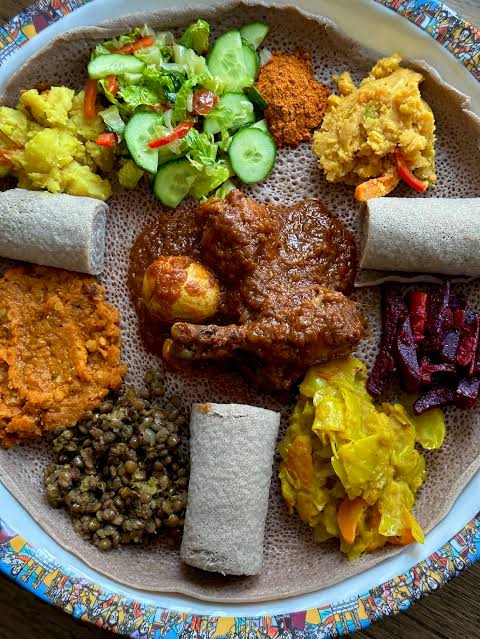
Doro wat served on injera with lentils, cabbage, salad and other sides. Source: The Farah Kitchen
The stew worth waiting for
Doro wat, often described as Ethiopia's national dish, is built on patience. It begins with a large quantity of red onions, cooked down slowly until they melt into a thick base. Berbere, a blend of dried chilies and spices, gives the sauce its deep red colour and heat, while garlic, ginger and niter kibbeh, a spiced clarified butter, add depth and richness. Chicken is simmered in the sauce until tender, and whole hard-boiled eggs are added near the end so they soak up the flavour.
Because it takes so much time, doro wat is traditionally reserved for special occasions. It is closely tied to the Ethiopian Orthodox calendar and appears at holidays such as Easter, Christmas and the Ethiopian New Year. After long periods of fasting, when the faithful avoid meat and dairy, doro wat is often the feast that marks the end. Many Orthodox Christians in Ethiopia fast on Wednesdays and Fridays and through Lent, which is why vegetable platters are so common and why a chicken feast feels so special.
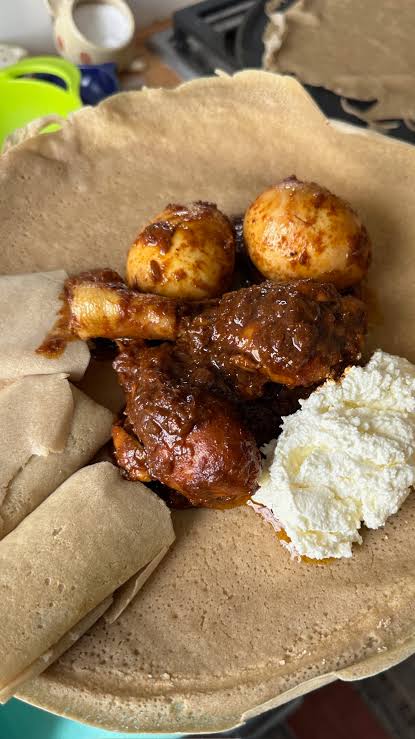
Doro wat with boiled eggs, served on injera. Source: africanbites.com
A platter, not just a plate
Doro wat rarely arrives alone. On a full platter it sits at the centre, surrounded by smaller portions of vegetable and lentil dishes such as misir wat (spiced red lentils), gomen (collard greens) and cabbage with carrots, along with a fresh salad. Ayib, a mild, crumbly fresh cheese, is often served alongside to cool the heat of the berbere. Each portion is distinct, yet they are meant to be eaten together, one scoop of injera at a time, so that every bite is a little different from the last.
Eating as an act of love
Injera is eaten communally, from one shared platter. A beloved custom is the gursha, where a person wraps a bite of food in injera and feeds it to someone else by hand. The bigger the gursha, the deeper the affection, and it is offered to friends, family and honoured guests alike. Declining it can feel like turning down a gesture of friendship.
It is a small act, but it says a lot. In this tradition, food is not only fuel. It is a way of showing love and respect.
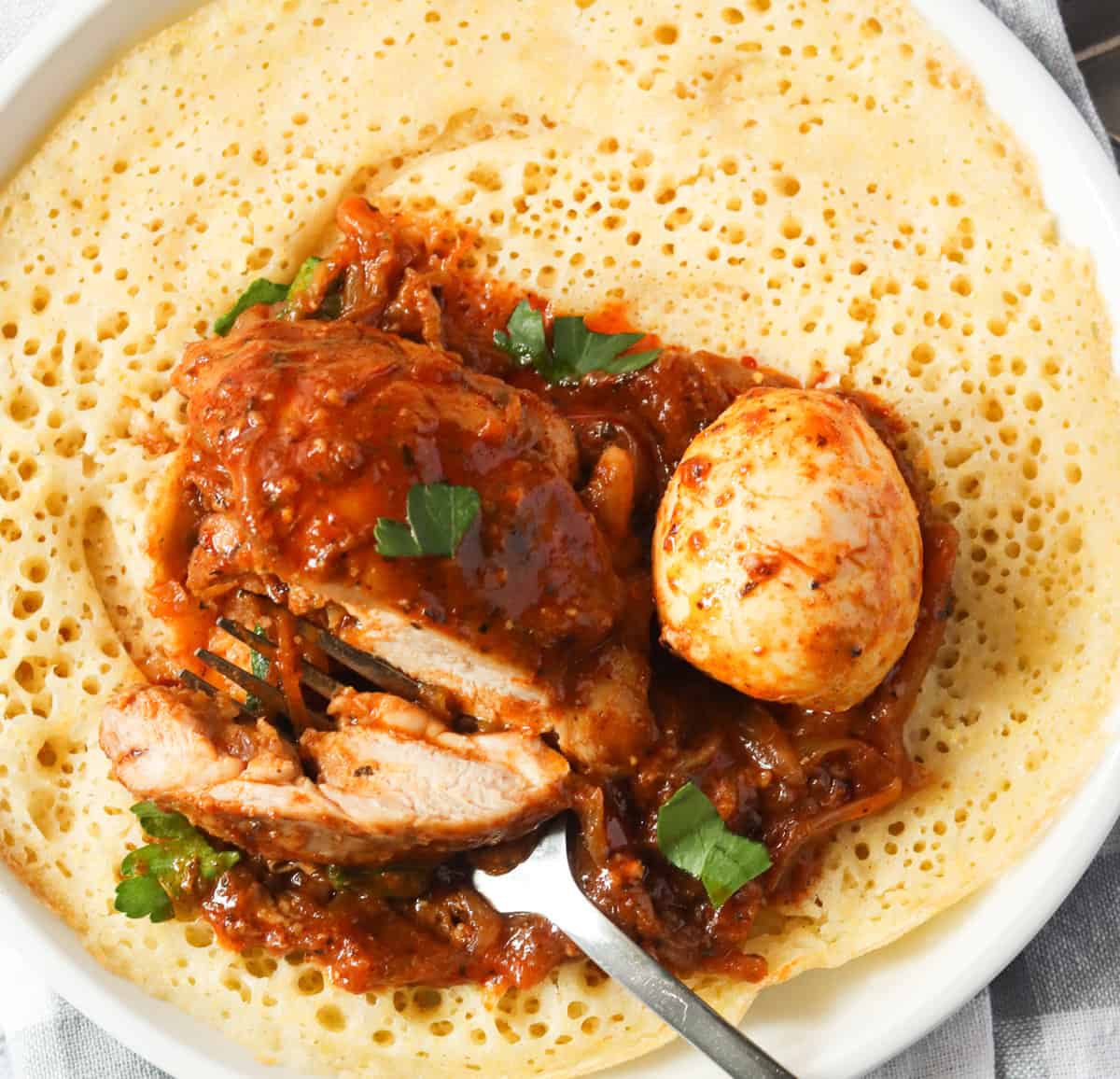
Chicken and egg in doro wat sauce on injera. Source: Immaculate Bites
A dish with a story for Africa
Beyond its flavour, injera with doro wat tells a story about African food heritage. Teff, once little known outside the region, has drawn global attention for its nutrition, and Ethiopian restaurants have introduced the dish to diaspora communities and curious diners in cities around the world. In Ethiopia and neighbouring Eritrea, similar breads and stews are part of everyday life and national identity. Yet at home, it remains what it has always been: a symbol of hospitality, faith and community.
For the rest of us across the continent, it is a reminder of how rich and varied African cuisine is, and how much there is to learn from each other's tables. Nigeria has its jollof rice and pounded yam. Ethiopia has its injera and doro wat. The dishes are different, but the idea is the same: good food is meant to be shared.
Anyone who gets the chance to try it should do so the traditional way, with friends, by hand, and with a willing gursha.


Comments (0)
Leave a Comment