
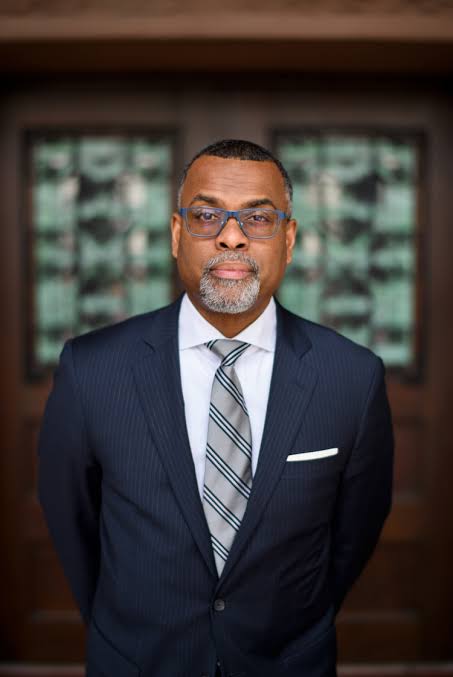
DR. EDDIE GLAUDE
A personal note before we begin
I am an African who has lived in Nigeria, and I share and understand some of the things Dr. Eddie Glaude Jr. talked about in this episode. One of them struck me hardest: his claim that Black Americans function like gold to the dollar. It is a sentence that sounds like a metaphor and lands like a diagnosis.
I first came across Dr. Glaude on Zeteo, speaking about America at 250 years. As a Nigerian who studied political science, the dynamics of the American political system have always interested me, and listening to him I was not only following a debate but learning. When I heard him sit down with the hosts of One54, two Nigerian-Americans, I realised I was watching something rare: a serious scholar of Black America speaking directly, and honestly, to the African diaspora’s children. This article is my attempt to understand more, and to share what I learned.
The One54 episode opens on a tension that many Africans and Black Americans know well. One host described growing up in Chicago, feeling both fully Nigerian and fully American, and his frustration at being called a “tether” by some Black Americans who use the term FBA, short for Foundational Black American. He said he has no problem with the label itself. His complaint was that he is studying Black history seriously and still being dismissed.
A weaker guest would have chosen a side. Glaude did something harder. He widened the frame, asked everyone to look at the longer story, and then explained why the argument feels so heated: it is a fight over scarce recognition, scarce resources and a shared history that has rarely been told in full.
Who is Eddie Glaude Jr.?
Eddie S. Glaude Jr. was born in Moss Point, Mississippi, and raised in Pascagoula. He left home at sixteen to attend Morehouse College, the alma mater of Dr. Martin Luther King Jr. He later earned a master’s degree in African American studies from Temple University and a master’s and doctorate in religion from Princeton. He began his teaching career at Bowdoin College, where he chaired the Department of Religion, and was a visiting scholar at Amherst and Harvard.
Today he is the James S. McDonnell Distinguished University Professor at Princeton University.When Princeton’s Center for African American Studies became a full academic department in 2015, he was its inaugural chair, a role he held until 2023. He is a former president of the American Academy of Religion and a founding member and senior fellow of the Jamestown Project. He also hosts Princeton’s AAS podcast, a conversation about African American studies and the Black experience in the twenty-first century.
He is often described as an American critic in the tradition of James Baldwin and Ralph Waldo Emerson, a description that tells you something about his method: he writes about politics and race as questions of moral and philosophical life, not only of policy.
His works
Glaude’s books form a clear intellectual arc, from the history of Black religion and nation-building to the politics of the present.
Exodus! Religion, Race, and Nation in Early Nineteenth-Century Black America was his first book. It won the Modern Language Association’s William Sanders Scarborough Book Prize and examined how free Black Americans used the biblical story of Exodus to imagine themselves as a people and a nation. For African readers, it is a reminder that Black American identity was built, from the start, through story and faith, much as many African nationalisms were.
In a Shade of Blue: Pragmatism and the Politics of Black America applied the American philosophy of pragmatism to Black political life. His religion titles, including An Uncommon Faith and African American Religion: A Very Short Introduction, brought the same rigour to the study of Black faith traditions.
Democracy in Black: How Race Still Enslaves the American Soul, published in 2016, argued that racial inequality is not a glitch in American democracy but part of how it has long worked. It introduced the idea of a “value gap”: the habit of valuing white lives and white concerns above Black ones, which shapes everything from policing to schooling. Bill Moyers praised the book as prophetic and full of inconvenient truths.
Begin Again: James Baldwin’s America and Its Urgent Lessons for Our Own, published in 2020, became a New York Times bestseller. It turns to Baldwin to ask why America keeps missing chances to begin again, and what Baldwin’s life and writing can teach a country in crisis. It is the book that sits behind the Baldwin reference he made on One54, the “price of the ticket.”
His legacy and impact on the African and Black American conversation
Glaude’s legacy is not only the books. It is the way he has changed the terms of the conversation, and three contributions stand out.
First, he insists that Black struggle has always been global. On One54 he reminded listeners that the usual story jumps from the 1920s to 1954 and ends in 1968, leaving out the 1930s and 40s, W. E. B. Du Bois, Paul Robeson and the Council on African Affairs. He pointed to the way Black Americans looked to Ethiopia, to Ghana’s independence, to Cuba and to the Congo. In his telling, the Cold War domesticated that story into a fight for American citizenship alone. This matters to Africans because it dismantles the idea that our histories run on separate tracks. Our liberation movements and theirs were in conversation long before social media.
Second, he separates race from ethnicity without pretending the difference is painless. In the United States, he explained, white supremacy racializes all Black bodies in the same way, yet beneath that sit Nigerians, Jamaicans, Haitians, African Americans and others. He drew on his own household: he comes from a diasporic family, and his wife is Jamaican. By naming this, he gives Africans and Black Americans vocabulary for a disagreement that otherwise collapses into insults.
Third, he refuses the lazy comparison. When people compare African immigrants with Black Americans, he argued, they are often comparing different class positions. The immigrants who arrive are frequently those who had the chance to leave. Their true counterparts are the resource-deprived back home, not the families left behind in America’s poorest neighbourhoods. He also acknowledged the competition over places at elite universities, and warned that such rivalry should not be mistaken for a clash of essences.
The most arresting moment came when Glaude said Black Americans function like gold to the dollar: they are at the bottom of the well, which gives meaning to whiteness, just as gold once gave meaning to the dollar. He then connected it to Baldwin’s idea of the price of the ticket, the bargain by which immigrant groups, historically white European ones, became accepted by distancing themselves from the bottom. His example of the Irish, drawing on Noel Ignatiev’s work on how the Irish became white, makes the point sharply.
The warning for African and Caribbean immigrants is plain. Distance from Black Americans can feel like safety, but it is the same old bargain, and it is paid for by someone else. Glaude was not shaming anyone. He was describing a mechanism, and mechanisms can be refused. Solidarity does not require sameness; it requires honesty about where each of us stands and who pays when we pretend otherwise.
Solidarity does not require sameness. It requires honesty about history, class and who pays the price of the ticket.
What this means for Africans at home
Many Africans in Africa follow these debates from a distance, through clips, tweets and arguments about words like “tether.” We often feel the heat without having the context. Glaude supplies the context. He shows that the quarrel is not a clash of good and bad people, but the product of history, immigration law, class and a global racial order that none of us built and all of us live inside.
It also raises a challenge. If Black American struggle has always been tied to Africa, from Ethiopia to Ghana to the Congo, what is Africa’s side of the relationship? Do we know their history as well as they, at their best, have tried to know ours? The hosts of One54 hinted at this when they spoke about their own efforts to study Black American history. Respect has to run in both directions.
TalkAfricaNG and the work of connecting a scattered family
This is also where TalkAfricaNG sees its own role. The platform is moving in the same direction as conversations like this one: connecting Africans in Africa, showing our stories on our own terms, and building a bridge to our diaspora cousins who live in Chicago, Houston, London and beyond.
For too long the African story has been told in pieces, with those at home, those abroad and those across the Atlantic speaking to each other mainly through stereotypes. Platforms like TalkAfricaNG exist to change that, by putting African voices, journalism and culture in front of readers everywhere and by creating space for exactly the kind of honest, difficult conversation Glaude modelled on One54. When a Nigerian reader in Osogbo and a Nigerian-American listener in Los Angeles can learn from the same scholar and the same story, the distance between us starts to shrink.
Conclusion
Dr. Eddie Glaude Jr. did not settle the argument between Africans and Black Americans in one episode, and he did not try to. What he offered is a better way to hold it: with history in view, with class and ethnicity named, and with the refusal to pay the old price of the ticket.
His books, from Exodus! to Begin Again, give us the long view. His One54 conversation gives us the human one. Between them, they point towards a family that can disagree without disowning one another, and an Africa that is finally part of the conversation as a speaker, not a topic. That is a conversation worth joining.


Comments (0)
Leave a Comment