
When we think of luxury leather, images of cowhide bags, jackets and shoes often come to mind. For centuries, animal leather has been associated with quality, durability and prestige. But a quiet revolution is taking root beneath our feet, quite literally.
Across the global fashion industry, scientists, designers and innovative material companies
are turning to an unexpected source: MUSHROOMS.
Not the mushrooms we eat, but MYCELIUM: the underground root-like network of fungi.
This remarkable natural material is proving that the future of fashion may not come from
farms, but from forests and laboratories.
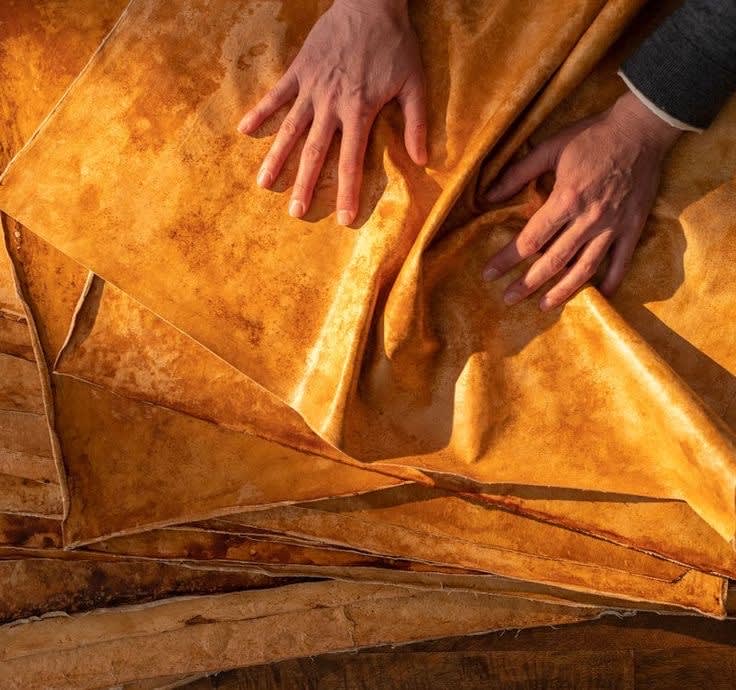
What Exactly Is Mushroom Leather?
Mushroom leather is made from mycelium, a dense network of tiny fungal fibres that grows
beneath the soil. Under carefully controlled conditions, mycelium can be cultivated into
sheets that resemble animal leather in texture and flexibility. After harvesting, the material is processed, strengthened and finished to create a leather-like product suitable for handbags, footwear, wallets and even clothing. Unlike traditional leather, no animal needs to be raised or slaughtered, and the material can be grown in just a few weeks.
Why Is the Fashion Industry Paying Attention?
Traditional leather production has long been admired for its durability, but it also comes with environmental challenges. Raising livestock requires significant land and water resources, while tanning leather often involves chemicals that can pollute surrounding ecosystems if not properly managed.
Mushroom leather offers an alternative that uses fewer natural resources and can often be produced more quickly. Because mycelium grows rapidly, manufacturers can cultivate new material in weeks instead of waiting years for livestock to mature.
For an industry under increasing pressure to reduce its environmental impact, this presents an exciting opportunity.
Luxury Brands Are Already Exploring It
This is no longer a concept confined to research laboratories.
Several luxury fashion houses and footwear companies have experimented with mycelium-based materials for limited collections, accessories and product prototypes.
Fashion houses like:
• Stella McCartney (Produced the first luxury garments made from Mylo, a mycelium-
based material. Later launched the Frayme Mylo handbag, one of the first commercially available luxury mushroom leather bags).
• Hermès (partnered with biotech company MycoWorks to create a version of its
Victoria travel bag using Sylvania, a fine mycelium material).
• Lululemon: collaborated with Bolt Threads to produce limited-edition yoga accessories and bags made from Mylo as part of the Mylo Consortium.
• Kering: Rather than launching its own products immediately, Kering (the parent
company of brands like Gucci, Balenciaga and Saint Laurent) invested in the Mylo
Consortium to help accelerate the development of mushroom leather technology.
• Adidas (developed the Stan Smith Mylo concept sneaker using mushroom-based
material).

While most mushroom leather products are still produced on a relatively small scale, interest continues to grow as technology improves.
The question is no longer whether mushroom leather works. The conversation has shifted to how quickly it can be produced at a scale that makes it widely available.
Can Mushroom Leather Replace Animal Leather Completely?
Not yet!
Animal leather still has advantages in terms of long-term durability for some applications and is supported by an established global supply chain.
Mushroom leather, meanwhile, is still developing. Manufacturers continue to improve its strength, consistency and m affordability so it can compete with conventional leather across a wider range of products. Rather than replacing animal leather overnight, mushroom leather is more likely to become one of several next-generation materials shaping the future of fashion.
Why This Matters Beyond Fashion
This innovation represents more than a new fabric. It reflects a broader shift in how designers think about materials. Instead of asking, “What can we take from nature?” the question is increasingly becoming, “How can we work with nature to create something better?”
As consumers become more interested in sustainability and responsible production, materials like mushroom leather challenge long-held assumptions about what luxury should look like.
Perhaps the next iconic handbag won’t begin on a cattle ranch. It may start with a living
network of fungi growing quietly beneath the earth. Fashion has always reinvented itself. This time, the future may be growing from the ground up.
As Africa continues to celebrate its rich leather-working traditions from handcrafted sandals to finely made bags, the rise of mushroom leather invites an important question: Can innovation and tradition exist side by side? Perhaps the future of fashion is not about replacing heritage, but expanding the materials through which we tell our stories.
©️Joy C. Popoola|TalkAfricang.com|2026



Comments (0)
Leave a Comment