
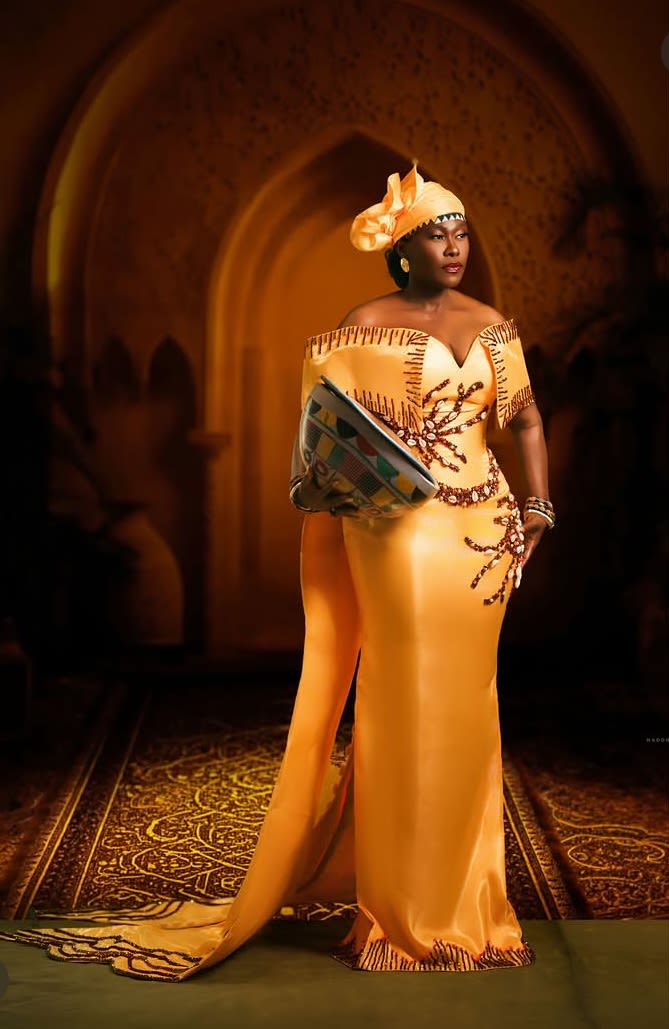
The Fulani identity is one of the most distinct in the world. It’s about a people who carry their home with them, who find beauty in the journey, and whose fashion is a map of where they’ve been.
There is a saying in the Sahel: "You can tell a person’s destination by the way they dress, but you can tell a Fulani woman’s history by the way she shines."
At the AMVCA, when we see a modern Fulani-inspired dress, we aren't just seeing a "look." We are seeing thousands of years of nomadic pride woven into a single silhouette.
Fulani dress is the ultimate symbol of "Beautiful Resilience."
Imagine a lifestyle where you are always on the move, crossing borders and deserts. How do you show your success? You don’t build a house; you wear it.
Fulani fashion is built on the concept of portable luxury. Every bead, every gold hoop, and every intricate embroidery pattern is a sign of status that moves with you. When you see a woman in a Fulani-inspired gown, you are looking at a "walking archive" of heritage. She doesn’t need a palace to look royal; she carries the palace on her back.
The Story in the Thread: More Than Just Patterns
What people need to know about a Fulani outfit is that nothing is there by accident.
The Colors: Usually, you’ll see the "Indigo of Dignity" or the "White of Purity." In modern reinterpretations, designers use vibrant colors, but they keep the embroidered storytelling. Those geometric shapes you see? They often represent migration paths, cattle horns (the lifeblood of the people), or the ripples of the sand.
The Accessories: The amber beads aren't just jewelry; they are heirlooms passed from mother to daughter. They represent protection on the journey. And the iconic gold Jimbe earrings? They are a shout of prosperity.
For the Fulani, dressing is not just about covering the body; it is about expressing status, beauty, and belonging.
And at the center of that expression is one thing: BEADS.
What immediately defines this look is its rich use of beads: layered, detailed, and symbolic.
In Fulani culture, beads are not random decoration. They represent:
· Identity
· Femininity
· Cultural pride
· Social expression
The way they sit on the body, the way they frame the face and neckline, everything is intentional.
In this outfit, the beads do more than complete the look.
They become the look.
They draw your eyes, hold your attention, and tell a story without needing explanation.
The Modern Reinterpretation: Tradition That Breathes
The magic happens when a designer takes these ancient elements: the heavy embroidery and the nomadic drapes and turns them into a high-fashion gown.
What the designers are doing today is brilliant: they are taking the "Hula" (the embroidered cap) or the "Gyale" (the veil) and making them the centerpiece of modern glamour. It’s a way of saying that the Fulani identity isn’t just for the village or the cattle path; it belongs on the global stage.
It’s a reinterpretation that says: "We are still here, we are still moving, and we are still the standard of beauty."
There is something distinct about Fulani style; it is graceful, yet commanding.
Unlike overly dramatic designs, Fulani-inspired fashion often carries a quiet confidence. And this outfit reflects that beautifully.
The silhouette is clean. The structure is intentional.
Nothing feels excessive, yet everything feels complete.
It shows that elegance does not always need to shout. Sometimes, it simply needs to exist with confidence.
Fulani dressing is not just aesthetic; it is cultural language.
It teaches us that:
· Adornment can carry identity
· Simplicity can still be powerful
· Culture can be expressed without losing elegance
It reminds us that African fashion is not one story; it is many stories, told in different ways.
This is more than a dress worn for an event.
It is Fulani pride, reimagined.
It is culture, made visible.
It is identity, worn with intention.
And in a space like the AMVCA, where fashion meets storytelling, this look stands as a reminder that sometimes, the most powerful statements are the ones deeply rooted in who we are.
©️Joy C. Popoola|TalkAfricang.com|2026


Comments (0)
Leave a Comment