
Alexander Zanders didn't set out to build a fintech company. He set out to grow food, and ran straight into the reason so much of Africa's farmland sits underfunded.
The UfarmX logo (Source:ufarmx.com)
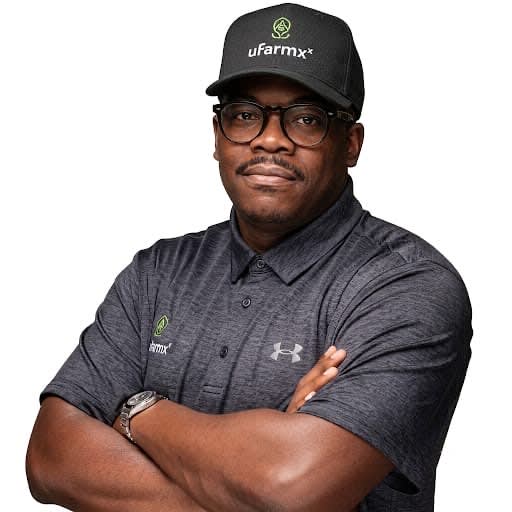
Alexander Zanders, founder and CEO of UfarmX. (Source: LinkedIn)
In 2020, while most of the world was learning to live indoors, Alexander Zanders did the opposite. He sold off his cryptocurrency holdings bought back when Bitcoin was still under $10 and used the money to buy 100 acres of farmland in Nigeria. He had no farming background. What he had was a question that had been forming since a trip through the American South years earlier, watching Black laborers picking cotton by hand in Moultrie, Georgia, and wondering why parts of Africa were still doing the same work the same way, generations later.
He ran the farm himself. And the thing that stopped him wasn't the soil, the weather, or the harvest. It was money specifically, the complete absence of it for the smallholder farmers around him. So he tried something small: he gave 15 local farmers seeds and fertilizer on credit, no collateral required, just a bet that they'd repay after harvest. By season's end, their yields had tripled and their revenues had doubled. That pilot became UfarmX.
THE PROBLEM IS BIGGER THAN ONLY ONE FARM
To understand why that small experiment mattered, you have to understand the scale of what it was pushing against. Africa holds close to 70 percent of the world's remaining arable land and is home to somewhere between 500 and 600 million smallholder farmers. And yet, by Zanders' own account, those farmers collectively spend only about $8 billion a year on seeds and fertilizer compared to roughly $100 billion spent annually in the United States, a country with just 3 million farmers.
The reason isn't a lack of ambition or a lack of land. It's that African smallholder farmers are, in the language of banking, largely "unbankable." More than 90 percent have no access to institutional credit, according to figures UfarmX cites, because they can't produce what a bank asks for: verifiable harvest records, land titles, a documented credit history. Less than 3 percent of commercial lending on the continent reaches agriculture at all. Zanders has a blunt way of putting the consequence: without capital upfront for inputs, farmers in some of the most fertile regions on Earth are producing at a fraction of what their land could actually yield.
WHAT UFARMX ACTUALLY DOES
UfarmX doesn't lend money directly. It builds the credit file that never existed. Field agents photograph each participating farmer, log GPS coordinates of their plots, and track input use, crop cycles, and repayment behavior over time. An AI model turns that data into a proprietary risk score something local agro-dealers can use to decide, in real time, whether to extend a farmer seeds and fertilizer on credit without collateral. An insurance partner backstops 80 percent of any default, funded through a small software fee built into the transaction.
Zanders describes the long-term goal in a single, ambitious sentence: becoming “the Equifax of African agricultural lending infrastructure”other banks and lenders eventually plug into, rather than a company that competes with them directly.
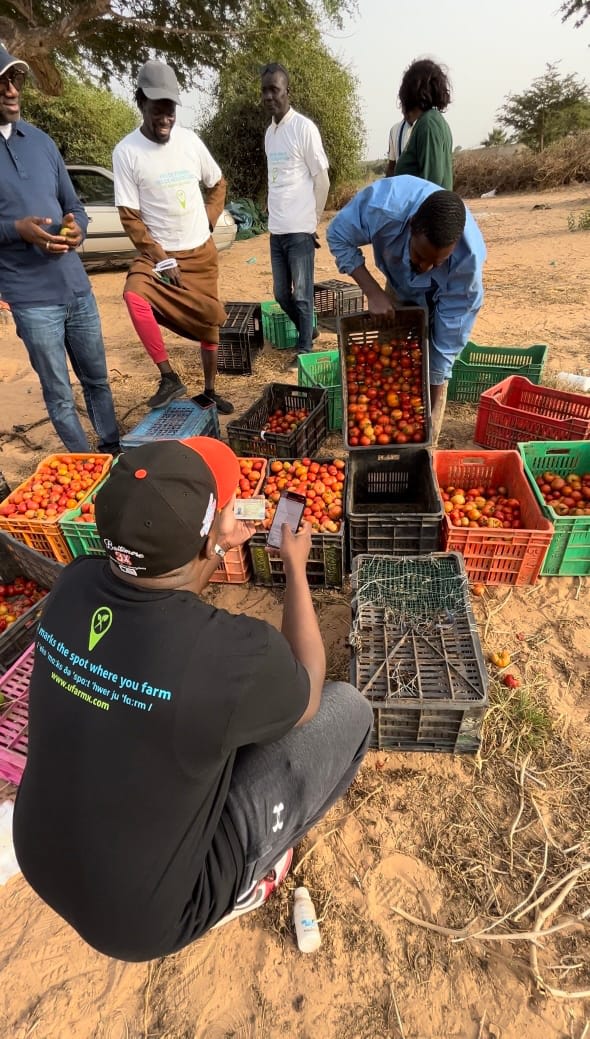
UfarmX field verification in progress at a tomato farm in Senegal — a farmer's ID and phone-based data being logged to build their credit profile. (Source: Medium)
THE HONEST NUMBERS
Here is where the story needs to be told carefully, because the gap between the ambition and the current scale is real, and pretending otherwise would do Zanders and his team no favours. As of mid-2026, UfarmX has credit-scored a little over 17,000 farmers and facilitated roughly $6.8 million in commerce, with a default rate reported around 1 to 9 percent depending on the measurement period genuinely strong by lending-industry standards, and evidence the model works. The company operates in Nigeria, its flagship market, along with Senegal and Liberia, with a Kenya launch targeted for later in 2026.
Total disclosed funding sits at a little over $3.3 million, raised through Techstars, Maryland's TEDCO fund, the Black Ambition prize which Zanders won outright in 2025 and Jedar Capital. Against a financing gap measured in the tens or hundreds of billions of dollars, that is, by any honest measure, a very small foothold. What UfarmX has built is proof of concept, not yet transformation at scale. The difference matters, and it's the difference between a promising pilot and the headline-grabbing "$100 billion opportunity" framing that's circulated in recent coverage.
WHY IT STILL MATTERS
That gap between current scale and continental ambition isn't a reason to dismiss the work it's the whole story of what African agri-fintech looks like at this stage. The financing hole UfarmX is trying to fill is one of the most persistent structural failures on the continent: land and labour that could feed far more people than they currently do, held back not by capability but by a banking system that has never figured out how to trust a farmer without a paper trail. If a credit-scoring model built from 17,000 real farmers can prove reliable enough for banks and insurers to eventually build on top of it, the model matters more than the current dollar figure attached to it.
Zanders, for his part, doesn't talk about the mission in purely financial terms. "It's not just data it's dignity," he has said of what the credit scores represent for farmers who have spent their working lives invisible to any formal financial system. Whether UfarmX becomes the infrastructure it hopes to be, or simply proves the model for whoever scales it next, the question it's asking why should 500 million farmers on the world's most arable continent remain locked out of the credit that would let them farm at their actual potential is one worth Africa's readers sitting with, regardless of how the company itself ultimately fares.
© 2026 Abdulmumin Ishola Olaleye | TalkAfricang.com


Comments (0)
Leave a Comment