From Danfo to a Digital Lagos: Two Nigerian Games Show What African Builders Can Do Figures are correct as of 8 October 2026 and change quickly.

From Danfo to a Digital Lagos: Two Nigerian Games Show What African Builders Can Do Figures are correct as of 8 October 2026 and change quickly.

Nigerians are not just playing a game this week. They are playing themselves. Two homegrown browser games, built around everyday life in Lagos, have taken over timelines and group chats.
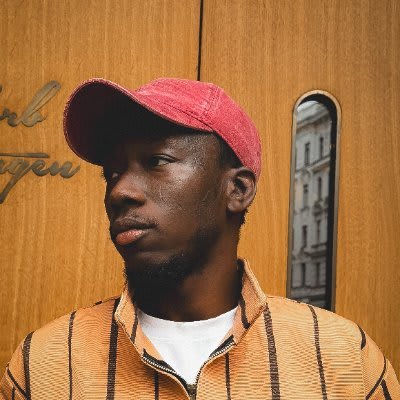
Opeyemi Adeniran ("Eureka")

Creator of Lagos Run

Ijeoma Shalom Rayhamen

Creator of Lagos Life

The danfo that started it

Lagos Run is a free browser game built by Opeyemi Adeniran, a Nigerian frontend engineer based in Berlin who goes by Eureka on X. You drive a yellow danfo through Lagos, pick up passengers, dodge traffic and chase a place on the leaderboard. There is nothing to download, no account to create and nothing to pay, so anyone with a phone and a link can play. According to Technext, it drew more than four million views across social platforms within days of its reveal.
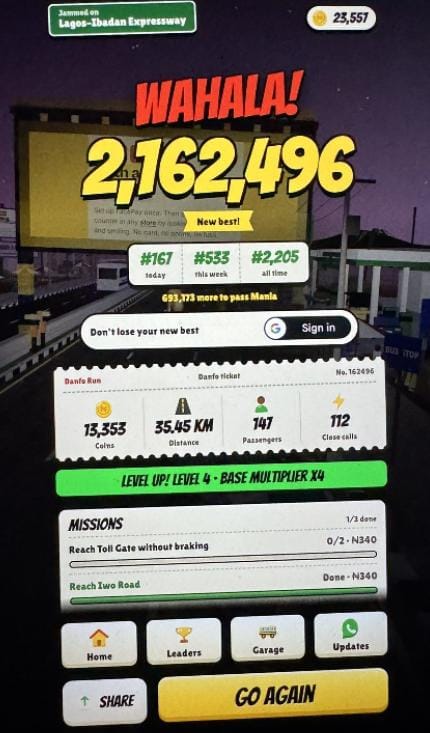
A results screen from the danfo game, with leaderboard ranks, daily missions and a garage. Screenshot supplied.

The danfo game is not a new idea. Nigerian studios such as ChopUp and Gamsole have made danfo-themed games for around a decade. Observers credit Lagos Run’s success to how closely it fits Lagos life and how easily it spreads online.

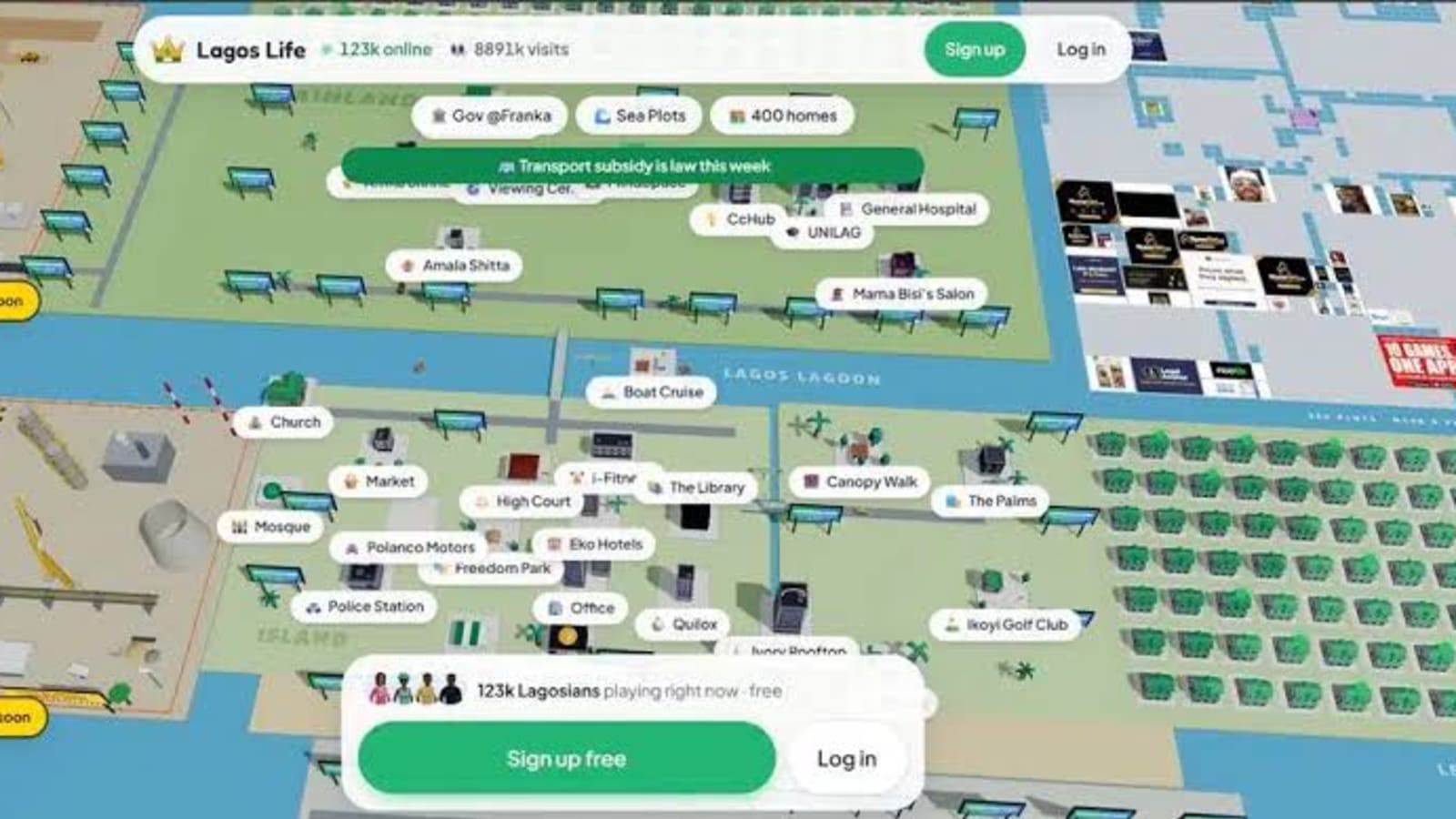
Lagos Life, which launched in early October 2026, takes the idea much further. Its creator, software developer Ijeoma Shalom Rayhamen, has said The Sims 3 and Lagos Run inspired it. Players live out a Lagos story, manage money and handle unexpected events in a virtual city. Landmarks on the map include a market, church, mosque, general hospital and police station.
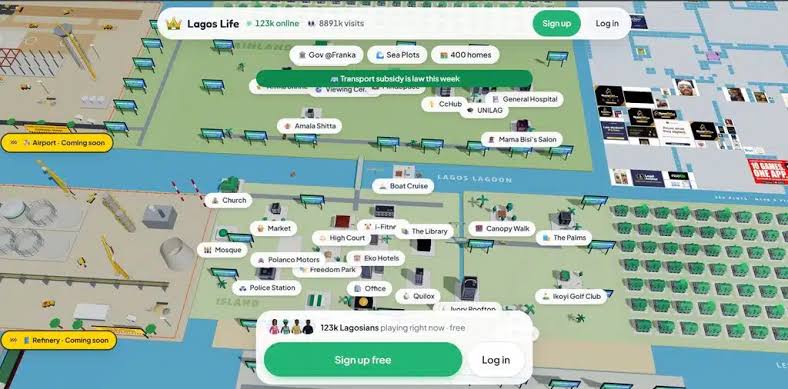
The Lagos Life map, with airport and refinery zones marked "coming soon". Source: Lagos Life

The growth has been fast. Technext reported that the game passed one million players in three days, and that its live counter on 5 October showed about 1.17 million total players. In a post on X, Shalom then announced two million players and the launch of Abuja and Port Harcourt maps, saying more than 101,000 people were playing at the same time.
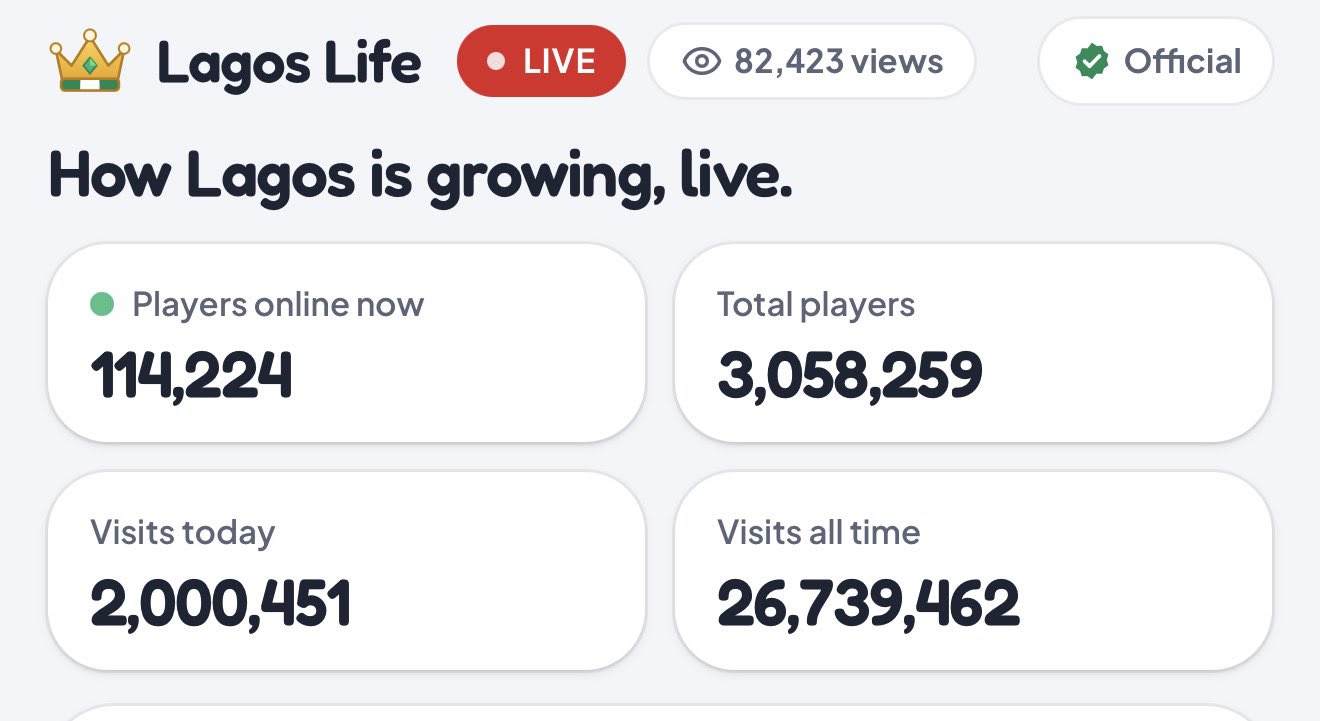
A screenshot of the game’s live stats page showed more than three million total players and over 26 million visits at the time it was captured. Lagos Life’s live stats panel. The numbers change by the minute. Source: Lagos Life

Interest in the game was not limited to Lagos. Technext, citing Google search data, reported that searches for "Lagos life" rose by more than 5,000% in a week, with the strongest interest in Ekiti, Ogun, Osun and Lagos.

Why this matters

These games show Nigerian developers building from what they know: the danfo, the hustle, the money talk and the pressure of Lagos life. That familiarity is what people share.

The idea also travels. Technext reported that within a day of seeing Lagos Run, another developer built a London version called Red Bus. A Nigerian idea became a template for other cities.

Lagos Run and Lagos Life are the loudest examples of something that has been building for years. Studios such as Maliyo Games, ChopUp and Gamsole built the early scene. AFP reported in January 2025 that Maliyo had grown from three to 36 employees in five years and runs its own online training programme across five African countries. Its founder, Hugo Obi, has noted that most games played in Nigeria are not Nigerian-made, which shows how much room there is to grow.

A newer group is following. Hfrogames, a three-person indie studio, released Idansquest in August 2025, a Lagos-set mobile runner about a graduate dodging "sapa", and Games Industry Africa called it a sign of a growing wave of African indie developers. Leadership newspaper has also profiled newer studios such as Anyhowanyhow Games, Dash Studio and Deluxe Creation Studio, which draw on everyday African life. On X, Nathan, CEO of Terra Industries, said simulation gaming is entering a new era of localised experiences, as Technext reported.

The wave still faces obstacles. Nigerian studios say funding is hard to find, intellectual property is seen as high-risk, and power and internet can be patchy. Even so, two solo-built browser games have reached millions of people, which shows what a small team with a local idea can do.

The potential

Commentators have suggested brand-wrapped danfos, in-game billboards and radio partnerships as ways Lagos Run could earn money. Lagos Life already has a persistent world, a live economy and more than one city, so in principle similar partnerships could work there too. The Abuja and Port Harcourt launches show the model can expand to more cities.

Going viral is easier than staying popular. Technext noted that a million players is not yet a million regular players, and whether Lagos Life can keep its audience is still unknown. There have been growing pains too. After an exploit inflated some players’ in-game funds, Arise reported that Shalom reset the affected balances, restored legitimate players’ funds and promised fixes. Players have also joked that they do not want real-life struggles in a game.

Two Nigerian developers, one danfo and one digital city have shown that African builders can create products millions of people choose to play. The next question is who builds the next one.

Share this article

Keep Reading

More stories you might find interesting

Injera and Doro Wat: The Dish Ethiopia Saves for Celebration
culture

Injera and Doro Wat: The Dish Ethiopia Saves for Celebration

In Ethiopia, a meal is rarely just about eating. It is about sitting together, sharing one platter and making sure no one at the table is left out. Few dishes capture this spirit better than injera with doro wat, a pairing of sour, spongy bread and fiery chicken stew that has anchored Ethiopian celebrations for generations.

Nigeria Confirms Ebola Case in Abuja as Health Authorities Trace 44 Contacts
health

Nigeria Confirms Ebola Case in Abuja as Health Authorities Trace 44 Contacts

Nigeria has confirmed an imported case of Ebola virus disease in the Federal Capital Territory, Abuja, after laboratory tests returned positive for a woman who recently travelled from Uganda, prompting health authorities to begin tracing people who may have been exposed to the infection. The Coordinating Minister of Health and Social Welfare, Professor Muhammad Ali Pate, confirmed the case on Tuesday, 20 October, stating that the patient had been isolated and was receiving medical care at a private hospital in Abuja. According to the minister, health officials have identified 44 contacts and commenced efforts to determine whether anyone else may have been exposed to the virus.

EcoLagos: The Future Of Waste Disposal & Recycling In Lagos State
health

EcoLagos: The Future Of Waste Disposal & Recycling In Lagos State

Lagos doesn't have a government problem, it has a habit problem, and the two keep getting confused. EcoLagos is building a smart waste management and recycling platform, developed with LAWMA, to digitize the city's entire waste value chain. The goal isn't just cleanup. It's getting Lagosians to see themselves as part of the system, one household and one habit at a time.

Comments (0)

Leave a Comment

0/1000
Loading comments...

From Danfo to a Digital Lagos: Two Nigerian Games Show What African Builders Can Do Figures are correct as of 8 October 2026 and change quickly.

From Danfo to a Digital Lagos: Two Nigerian Games Show What African Builders Can Do Figures are correct as of 8 October 2026 and change quickly.

Nigerians are not just playing a game this week. They are playing themselves. Two homegrown browser games, built around everyday life in Lagos, have taken over timelines and group chats.

Opeyemi Adeniran ("Eureka")

Creator of Lagos Run

Ijeoma Shalom Rayhamen

Creator of Lagos Life

The danfo that started it

Lagos Run is a free browser game built by Opeyemi Adeniran, a Nigerian frontend engineer based in Berlin who goes by Eureka on X. You drive a yellow danfo through Lagos, pick up passengers, dodge traffic and chase a place on the leaderboard. There is nothing to download, no account to create and nothing to pay, so anyone with a phone and a link can play. According to Technext, it drew more than four million views across social platforms within days of its reveal.

A results screen from the danfo game, with leaderboard ranks, daily missions and a garage. Screenshot supplied.

The danfo game is not a new idea. Nigerian studios such as ChopUp and Gamsole have made danfo-themed games for around a decade. Observers credit Lagos Run’s success to how closely it fits Lagos life and how easily it spreads online.

Lagos Life, which launched in early October 2026, takes the idea much further. Its creator, software developer Ijeoma Shalom Rayhamen, has said The Sims 3 and Lagos Run inspired it. Players live out a Lagos story, manage money and handle unexpected events in a virtual city. Landmarks on the map include a market, church, mosque, general hospital and police station.

The Lagos Life map, with airport and refinery zones marked "coming soon". Source: Lagos Life

The growth has been fast. Technext reported that the game passed one million players in three days, and that its live counter on 5 October showed about 1.17 million total players. In a post on X, Shalom then announced two million players and the launch of Abuja and Port Harcourt maps, saying more than 101,000 people were playing at the same time.

A screenshot of the game’s live stats page showed more than three million total players and over 26 million visits at the time it was captured. Lagos Life’s live stats panel. The numbers change by the minute. Source: Lagos Life

Interest in the game was not limited to Lagos. Technext, citing Google search data, reported that searches for "Lagos life" rose by more than 5,000% in a week, with the strongest interest in Ekiti, Ogun, Osun and Lagos.

Why this matters

These games show Nigerian developers building from what they know: the danfo, the hustle, the money talk and the pressure of Lagos life. That familiarity is what people share.

The idea also travels. Technext reported that within a day of seeing Lagos Run, another developer built a London version called Red Bus. A Nigerian idea became a template for other cities.

Lagos Run and Lagos Life are the loudest examples of something that has been building for years. Studios such as Maliyo Games, ChopUp and Gamsole built the early scene. AFP reported in January 2025 that Maliyo had grown from three to 36 employees in five years and runs its own online training programme across five African countries. Its founder, Hugo Obi, has noted that most games played in Nigeria are not Nigerian-made, which shows how much room there is to grow.

A newer group is following. Hfrogames, a three-person indie studio, released Idansquest in August 2025, a Lagos-set mobile runner about a graduate dodging "sapa", and Games Industry Africa called it a sign of a growing wave of African indie developers. Leadership newspaper has also profiled newer studios such as Anyhowanyhow Games, Dash Studio and Deluxe Creation Studio, which draw on everyday African life. On X, Nathan, CEO of Terra Industries, said simulation gaming is entering a new era of localised experiences, as Technext reported.

The wave still faces obstacles. Nigerian studios say funding is hard to find, intellectual property is seen as high-risk, and power and internet can be patchy. Even so, two solo-built browser games have reached millions of people, which shows what a small team with a local idea can do.

The potential

Commentators have suggested brand-wrapped danfos, in-game billboards and radio partnerships as ways Lagos Run could earn money. Lagos Life already has a persistent world, a live economy and more than one city, so in principle similar partnerships could work there too. The Abuja and Port Harcourt launches show the model can expand to more cities.

Going viral is easier than staying popular. Technext noted that a million players is not yet a million regular players, and whether Lagos Life can keep its audience is still unknown. There have been growing pains too. After an exploit inflated some players’ in-game funds, Arise reported that Shalom reset the affected balances, restored legitimate players’ funds and promised fixes. Players have also joked that they do not want real-life struggles in a game.

Two Nigerian developers, one danfo and one digital city have shown that African builders can create products millions of people choose to play. The next question is who builds the next one.

Share this article

Comments (0)

Leave a Comment

0/1000
Loading comments...