
Sabastian Sawe has etched his name into the history books, becoming Kenya’s first officially recognized sub-two-hour marathon champion. In a sport long defined by endurance, discipline, and incremental progress, Sawe has shattered one of its most elusive barriers, delivering a performance that now stands as a defining moment not just for Kenya, but for the entire world of long-distance running.

For years, the idea of completing a marathon in under two hours hovered between ambition and near impossibility. While Eliud Kipchoge famously broke the barrier in 2019, his feat came under controlled conditions that rendered it unofficial. Sawe’s achievement, however, carries the weight of legitimacy. It was done in a sanctioned race, under standard competitive rules, placing him in a league of his own as the first to make the sub-two-hour marathon a recognized reality.
Running through a course that tested both physical limits and mental resilience, Sawe maintained an extraordinary pace from start to finish. There was no dramatic fade, no visible moment of doubt. Instead, what unfolded was a masterclass in precision and stamina. Each split told the story of an athlete in complete control, pushing beyond what had previously been accepted as human limitation.
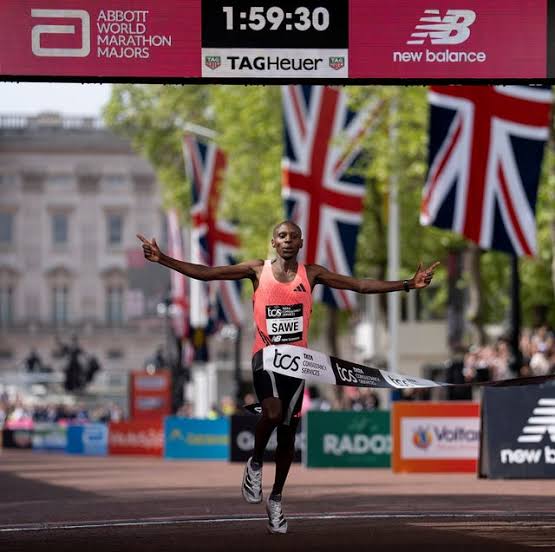
Kenya, already revered as a powerhouse in long-distance running, finds its legacy deepened by this landmark moment. From the high-altitude training grounds that have produced legends to the global stages where Kenyan athletes consistently dominate, Sawe’s triumph feels both like a continuation and a bold new chapter. It signals a shift in what is now possible, raising the bar for a new generation of runners who will chase this historic benchmark.
Beyond records and recognition, this achievement resonates on a deeper level. It challenges long-held assumptions about human endurance and redefines the ceiling of athletic performance. Sawe did not just win a race. He expanded the boundaries of the sport itself.
As the dust settles on this historic run, one thing is certain. The marathon will never be seen the same way again. And at the center of that transformation stands Sabastian Sawe, the man who turned a dream into an official reality.



Comments (0)
Leave a Comment